
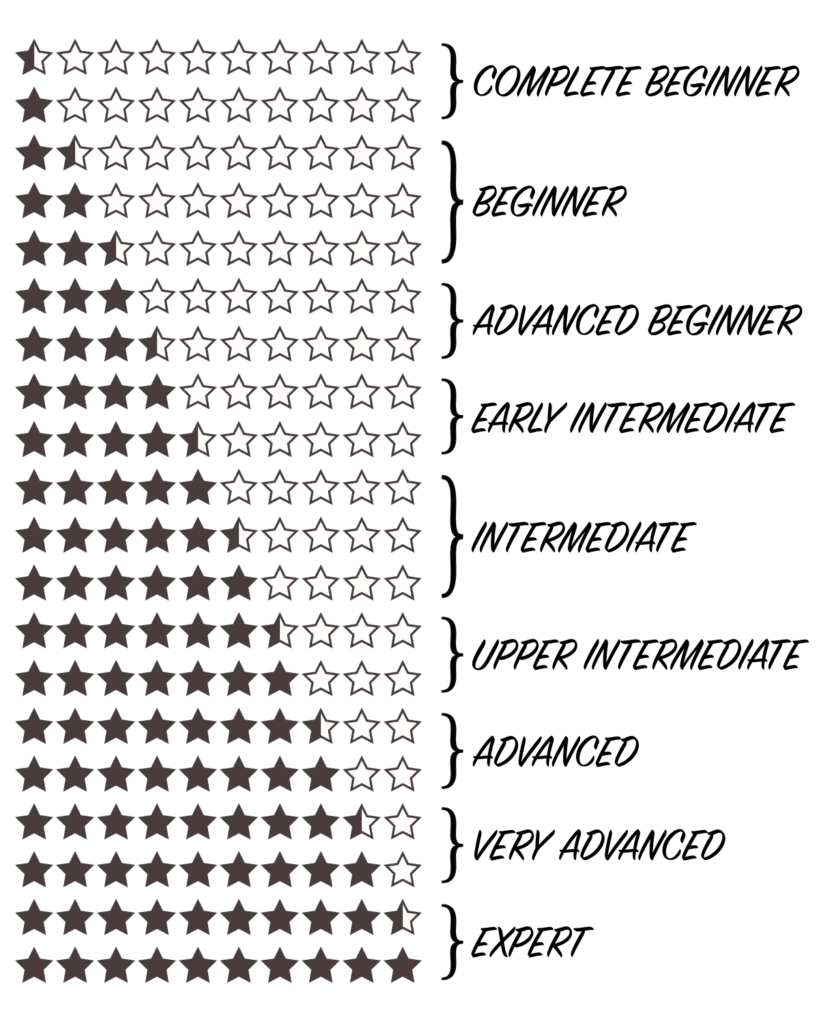
Every student learns at a different pace. For this scale, I assume an average-talented but motivated student who practices regularly (almost every day for about 30 minutes).
Under these conditions, a student can expect to reach the next level after roughly six months (half a year = half a star), meaning that all 20 levels can theoretically be completed in about ten years.
The first levels (Complete Beginner and Beginner) can usually be progressed through much more quickly than indicated here. Reaching the highest levels (Very Advanced and Expert), however, requires considerable effort, persistence, and dedication.
The level assigned to a piece refers to the ability to perform it in concert, at a typical tempo and without major mistakes. Students often attempt pieces that are well above their actual level and may feel that they can already play them. In reality, they are often playing significantly below the intended tempo or leaving out notes, difficult passages, or even entire sections.
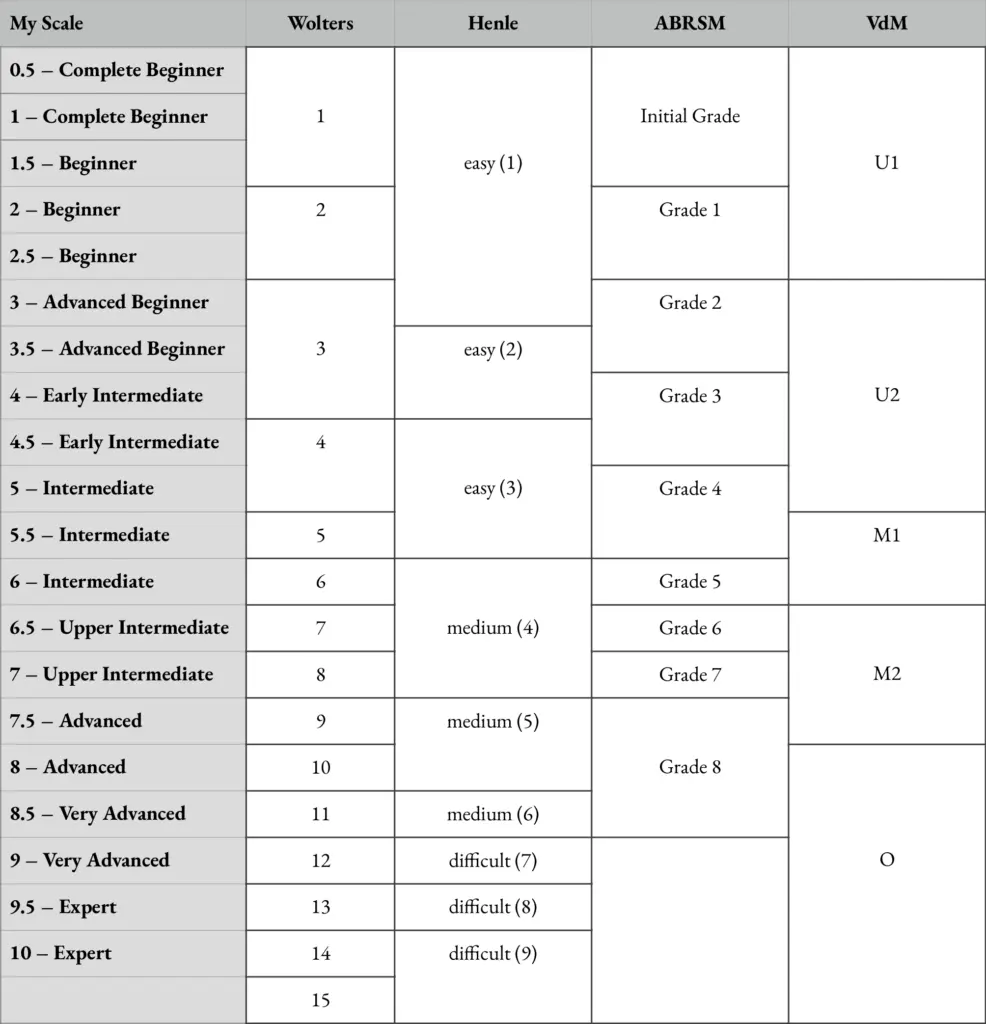
You are familiar with other scales?
Here is a rough comparison of my scale with the following well-known systems:
Please note that such a comparison is always very approximate and may vary considerably in individual cases – especially since the classification into difficulty levels can be quite subjective in some cases.
This website uses cookies to ensure that embedded videos, basic functions, and the site itself work correctly. By clicking “Accept”, you consent to the use of these cookies. No personal data is used for tracking or advertising.